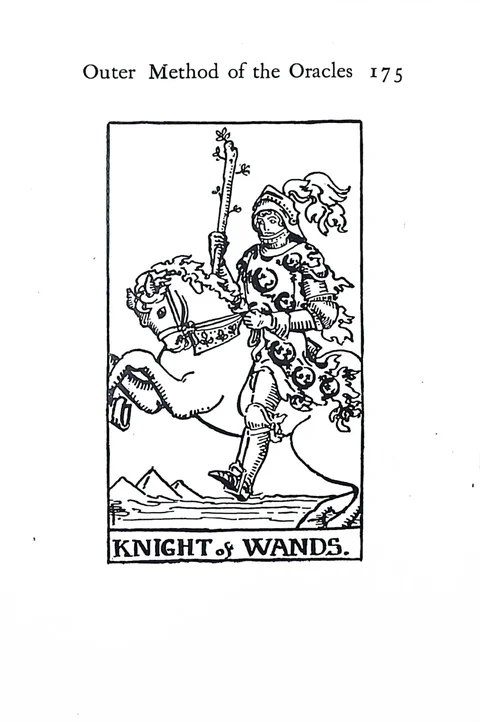
← TarotWaite–Smith has Kings, Queens, Knights and Pages. Thoth has Knights, Queens, Princes and Princesses. Crowley’s Knight is the Father in his four-part formula; his Prince is the Son. Comparing pictures can bring the two mounted Knights together, while comparing family rank can place a Thoth Knight beside a Waite–Smith King.
Why the names differ
Book T first calls its mounted paternal figures Kings and its charioted sons Princes (printed pp. 156–158). Its individual descriptions then use Knight and King. A footnote on p. 159 explicitly acknowledges the change and tells the reader to follow the horse and chariot when identifying the two forces.
Book T · court introduction, printed pp. 156–158 ↗
Book T · naming footnote, printed p. 159 ↗
Crowley later chooses Knight, Queen, Prince and Princess for Father, Mother, Son and Daughter. His elemental combinations belong to that scheme. Waite’s descriptions of his own plates are a separate witness: a title in Book T is insufficient evidence for assigning its whole formula to a Smith picture.
The Book of Thoth · Part I, “The Tarot and the Elements” ↗
Knight
Father · Yod · Fire
A rider on horseback. Begins the elemental action: immediate force whose first impulse can pass quickly.
Queen
Mother · Heh · Water
A figure on a throne. Receives the initial force, develops it and sustains its activity.
Prince
Son · Vau · Air
A figure in a chariot. Carries the combined force of the preceding pair into a distinct expression.
Princess
Daughter · Final Heh · Earth
A standing or dancing figure. Gives the process material form; Crowley also describes a return into stillness.
The Book of Thoth · Part III, “General Characteristics of the Four Dignitaries” ↗
These family and gender terms describe Crowley’s historical symbolic model. They need not describe the identity or family of a person using the cards. The linked Book of Thoth is a modern transcription; Book T is a facsimile.
Why contemporary guides disagree
The correspondence guide hosted by Daniel Tarr adopts the family-rank convention, pairing Thoth’s Knight with the King and Prince with the Knight. Chris Gabriel’s “The King and Prince of Cups” instead places the Waite–Smith King beside the Thoth Prince. The selector exposes that difference as a choice of comparison, without declaring the cards identical.
Tarr’s correspondence guide · modern interpretation ↗
Gabriel · “The King and Prince of Cups” · 28 February 2025 ↗
A way to look
Start with a particular card and its edition. Describe the figure, gesture and setting before adding another author’s correspondences. Then write what the comparison reveals—and what it leaves unresolved.
Waite’s introduction to the lesser cards distinguishes his divinatory pictures from a systematic account of higher symbolism. Read that qualification alongside his individual entries.
Waite · Part III, §1, printed pp. 166–169 ↗
Original comparison exercise and source summaries · magical.skin
All sixteen Smith courts