
Dodal
Le Chariot · VII
A crowned figure stands beneath a canopy, holding a baton. Two horses fill the lower part of the card, with their heads turned apart. The shoulder ornaments resemble faces.
Two horses become two sphinxes, then four composite creatures. Meanwhile, the figure’s hands acquire a different task. Count what is in front of the vehicle, then look at its centre.
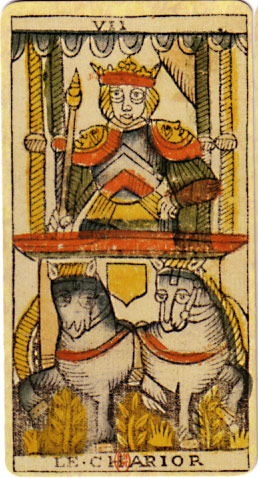
Jean Dodal · Lyon, 1701–1715
Open the source image ↗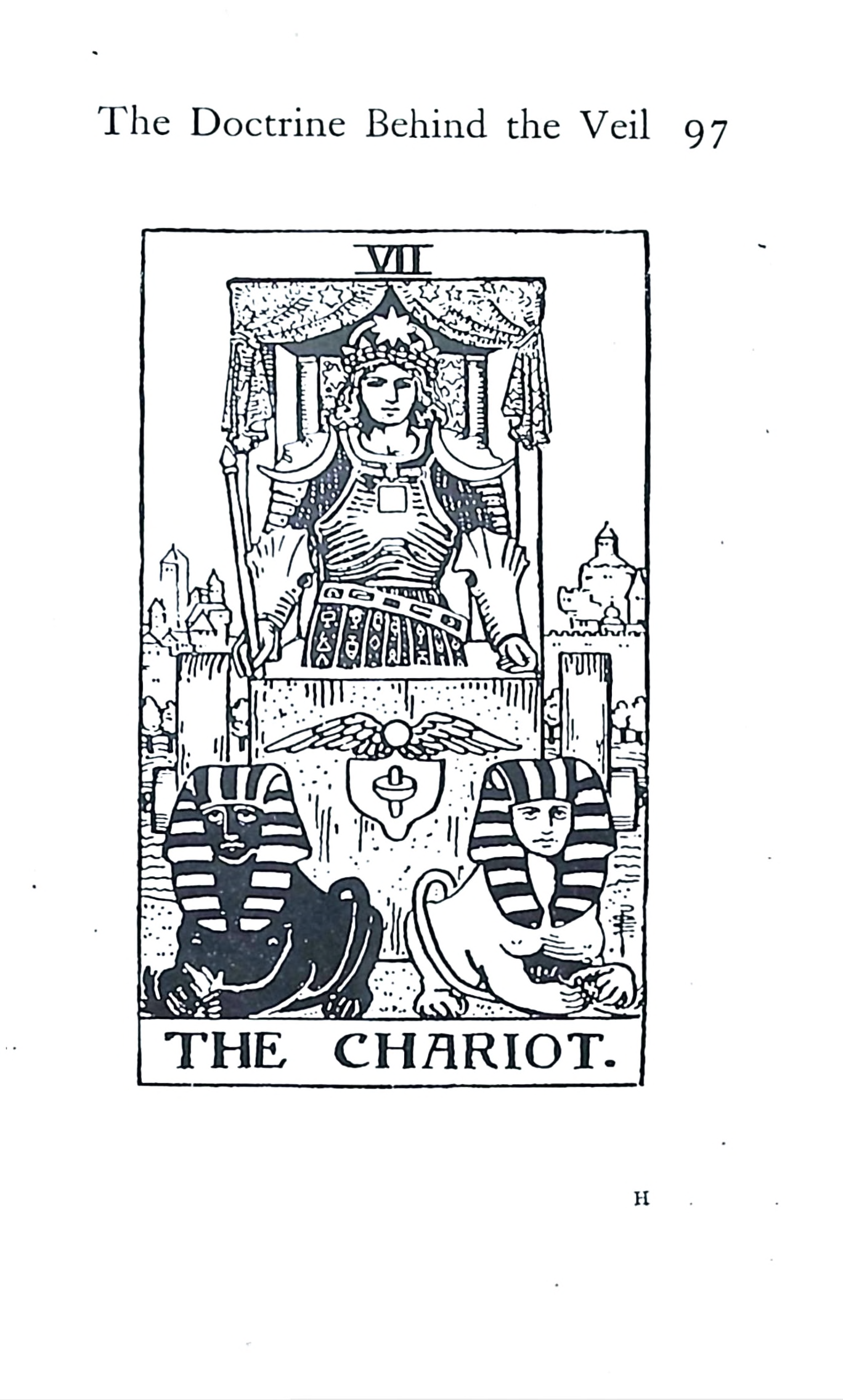
Pamela Colman Smith · 1922 printing, p. 97
Open the source scan page ↗Dodal
A crowned figure stands beneath a canopy, holding a baton. Two horses fill the lower part of the card, with their heads turned apart. The shoulder ornaments resemble faces.
Smith
Two seated sphinxes, one dark and one light, occupy the foreground. A starry canopy rises behind the armoured figure. The held implement has a narrow shaft and shaped tip; the city lies behind the vehicle.
Harris
The face is covered by a visor. Both hands support a large circular vessel, and four different animal-headed figures sit in front of the chariot. A crab-shaped crest rests above the helmet.
Open Harris’s painting and reference page ↗Waite accepts Lévi’s sphinx variation and calls the card a triumph of the mind. He also limits that victory: outward or rational conquest need not free the conqueror inwardly.
Crowley makes bearing the Grail the charioteer’s task. He explains the four sphinxes as combinations of the Kerubic forms and relates the armour and crab to Cancer.
Write one thing you can point to in the image, one interpretation from a named author, and one inference of your own. Keeping the three separate gives you something useful to revisit.
Gabriel develops a modern reading of territory and protection. Compare it with Waite’s limits on conquest and Crowley’s focus on the Grail; those emphases need not collapse into one keyword.
The Dodal cards are one early-eighteenth-century Marseille witness. The black-and-white Smith plates come from the 1922 Rider reprint, whose title verso lists first publication in 1910. Colours in later editions can differ.
The images shown here are reproduced from public-domain sources, with their original borders and page context.
Harris’s paintings are linked on their host’s reference pages. Crowley’s text is the separately identified Thelemagick transcription of The Book of Thoth. Neither a modern reproduction nor a transcription replaces examination of the original artwork or edition.
