
Dodal
L’Empereur · IIII
A bearded, crowned figure turns to the left, holding an orb-and-cross sceptre. The legs cross beside an eagle-emblem shield. One hand rests near the belt; the seat curves behind the body.
Look at the legs before the crown. Dodal’s turned figure, Smith’s frontal throne and Harris’s crossed-leg arrangement give authority a different physical stance.
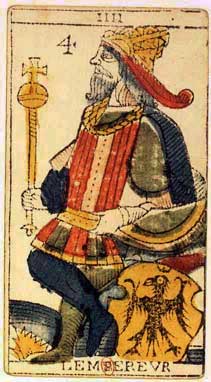
Jean Dodal · Lyon, 1701–1715
Open the source image ↗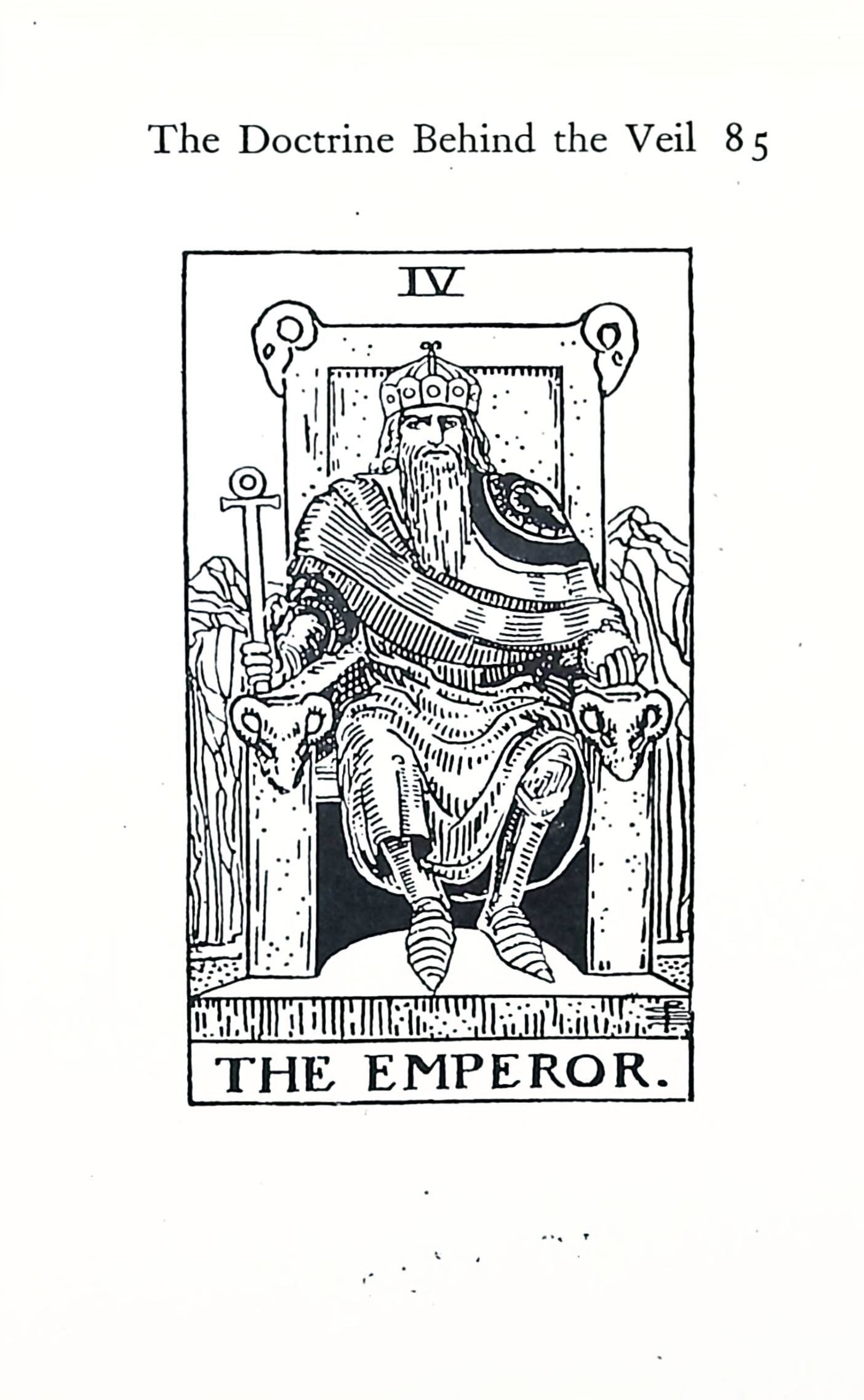
Pamela Colman Smith · 1922 printing, p. 85
Open the source scan page ↗Dodal
A bearded, crowned figure turns to the left, holding an orb-and-cross sceptre. The legs cross beside an eagle-emblem shield. One hand rests near the belt; the seat curves behind the body.
Smith
A crowned, bearded figure sits on a throne decorated with rams’ heads, holding an orb and an ankh-shaped sceptre. Armoured legs appear beneath the robe.
Harris
The crowned figure faces sideways between large ram heads. One leg crosses horizontally above the other. A sceptre, an orb, a bird-emblem shield and a lamb with a flag fill the surrounding space.
Open Harris’s painting and reference page ↗Waite begins with worldly authority and its execution, then adds intellectual kingship. He cautions that the Emperor and Empress cannot be reduced simply to a married couple.
Crowley connects the posture with alchemical Sulphur and Aries.
Write one thing you can point to in the image, one interpretation from a named author, and one inference of your own. Keeping the three separate gives you something useful to revisit.
The contemporary essay considers sovereignty and its burdens. Keep that application alongside the authors’ accounts, including the different names given to the shield emblem.
The Dodal cards are one early-eighteenth-century Marseille witness. The black-and-white Smith plates come from the 1922 Rider reprint, whose title verso lists first publication in 1910. Colours in later editions can differ.
The images shown here are reproduced from public-domain sources, with their original borders and page context.
Harris’s paintings are linked on their host’s reference pages. Crowley’s text is the separately identified Thelemagick transcription of The Book of Thoth. Neither a modern reproduction nor a transcription replaces examination of the original artwork or edition.
