Dodal, linked reproduction
Six de Coupes
Jean Dodal’s Marseille pack · Lyon, 1701–1715.
Read the BnF catalogue record ↗Flowers connect all three pictures, but their relation to the cups changes.
Dodal, linked reproduction
Jean Dodal’s Marseille pack · Lyon, 1701–1715.
Read the BnF catalogue record ↗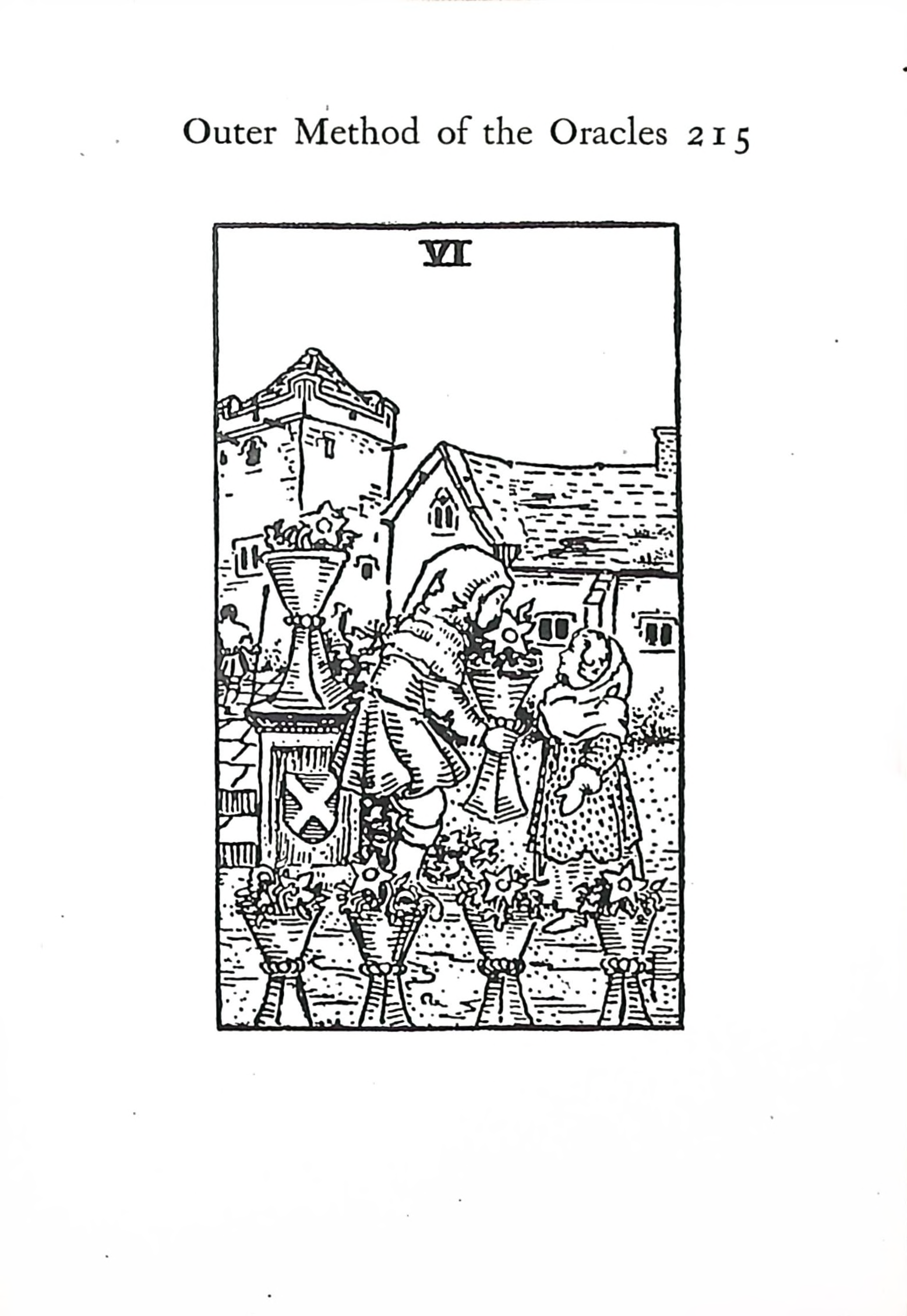
Pamela Colman Smith · 1922 printing, p. 215
Open the source scan page ↗Dodal
Six cups stand in two columns of three. A branching plant rises between them, with curled leaves filling the spaces beside the vessels.
Smith
Two small figures stand among flower-filled cups in a walled garden. One offers a cup to the other.
Harris
Six orange-red cups receive water from flowers on branching stems. The curved stems create a repeated, flowing arrangement against blue water.
Open Harris’s painting and reference page ↗Waite’s principal account looks toward childhood and past happiness, while another reading introduces new surroundings and relationships. The same garden therefore does not force every reader into a single temporal direction.
Crowley calls this Pleasure and joins Tiphareth with the Sun in Scorpio. He explains it as ease and the harmonious operation of natural forces, distinguishing it from the simple satisfaction of an appetite.
Write one thing you can point to in the image, one interpretation from a named author, and one inference of your own. Keeping the three separate gives you something useful to revisit.
The Dodal cards are one early-eighteenth-century Marseille witness. The black-and-white Smith plates come from the 1922 Rider reprint, whose title verso lists first publication in 1910. Colours in later editions can differ.
Foolmade supplies the linked Dodal reproductions. Its surrounding commentary is not the basis for our historical claims. These images are linked externally; the Smith illustration reuses the public-domain source scan with its full page context.
Harris’s paintings are linked on their host’s reference pages. Crowley’s text is the separately identified Thelemagick transcription of The Book of Thoth. Neither a modern reproduction nor a transcription replaces examination of the original artwork or edition.