Dodal
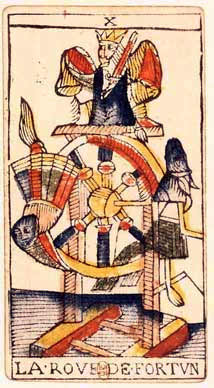
La Roue de Fortune · X
A wheel stands on a wooden frame with a projecting handle. Creatures cling to either side; a crowned, winged creature sits above the rim holding a sword-like implement.
A wheel on a visible support becomes a wheel suspended among creatures, clouds or lightning. Follow what holds it in place, and what appears to move around it.
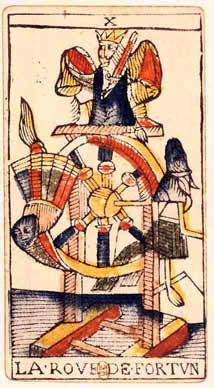
Jean Dodal · Lyon, 1701–1715
Open the source image ↗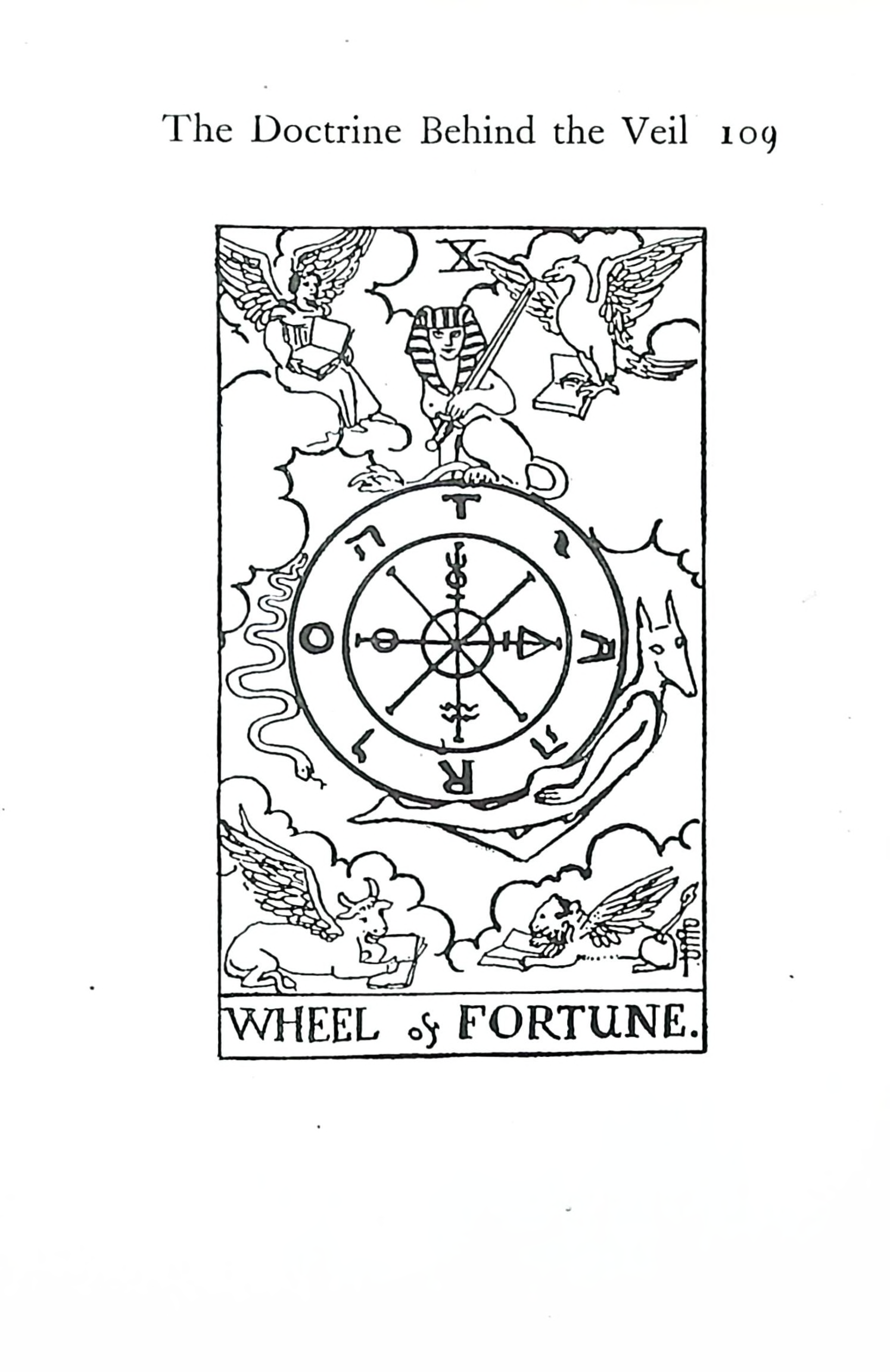
Pamela Colman Smith · 1922 printing, p. 109
Open the source scan page ↗Dodal
A wheel stands on a wooden frame with a projecting handle. Creatures cling to either side; a crowned, winged creature sits above the rim holding a sword-like implement.
Smith
A wheel marked with letters and symbols is flanked by descending and rising creatures. A sword-bearing sphinx sits above, and four winged figures occupy the corners.
Harris
A ten-spoked wheel hangs among stars and lightning. A sword-bearing creature rests at the top; two differently shaped creatures curve around the sides. No wooden support reaches the ground.
Open Harris’s painting and reference page ↗Waite describes movement in the universe and human life, with the sphinx supplying equilibrium. He allows Egyptian imagery for symbolic purposes while explicitly refusing to make its use proof of Egyptian origins.
Crowley emphasizes change and Jupiter’s unpredictable factor.
Write one thing you can point to in the image, one interpretation from a named author, and one inference of your own. Keeping the three separate gives you something useful to revisit.
Gabriel develops the changing positions of the figures into a reading of fortune. Compare that with the pictured mechanism and the authors’ separate explanations before treating it as a prediction.
The Dodal cards are one early-eighteenth-century Marseille witness. The black-and-white Smith plates come from the 1922 Rider reprint, whose title verso lists first publication in 1910. Colours in later editions can differ.
The images shown here are reproduced from public-domain sources, with their original borders and page context.
Harris’s paintings are linked on their host’s reference pages. Crowley’s text is the separately identified Thelemagick transcription of The Book of Thoth. Neither a modern reproduction nor a transcription replaces examination of the original artwork or edition.
