
Dodal
Force · XI
A broad-hatted figure bends toward a lion, with both hands at its mouth. The lion’s head turns upward toward the figure. The robe and mane occupy most of the lower card.
The human figure moves from beside a lion to the back of a many-headed beast. Look at contact, posture and direction before naming the relationship control or surrender.
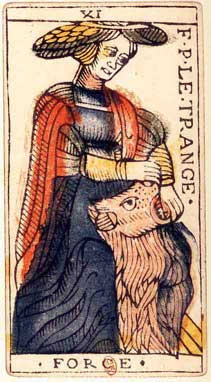
Jean Dodal · Lyon, 1701–1715
Open the source image ↗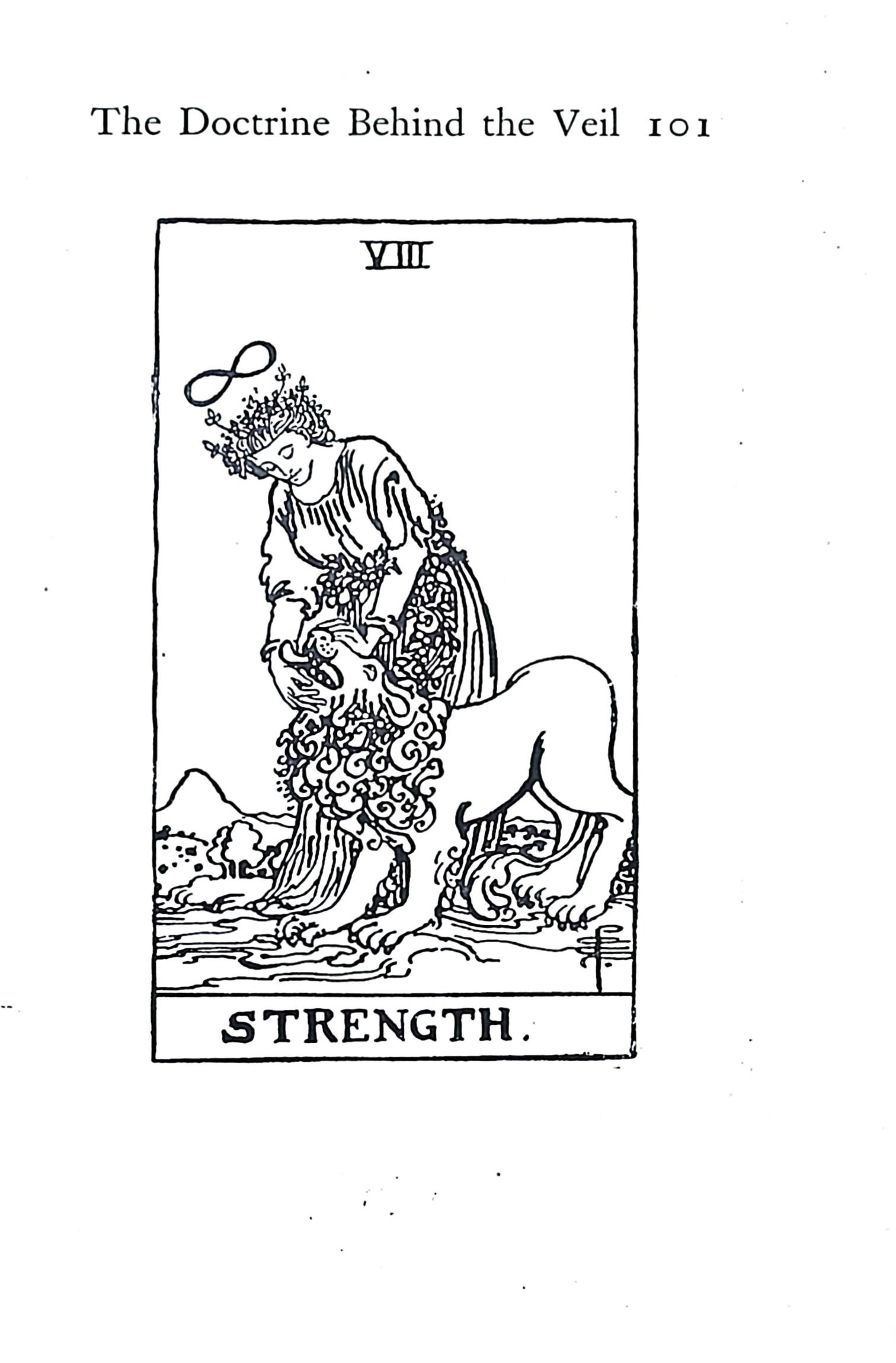
Pamela Colman Smith · 1922 printing, p. 101
Open the source scan page ↗Dodal
A broad-hatted figure bends toward a lion, with both hands at its mouth. The lion’s head turns upward toward the figure. The robe and mane occupy most of the lower card.
Smith
A flower-crowned figure bends over a lion, with both hands at its jaws. A horizontal loop appears above her head, and flowers encircle her waist.
Harris
A nude rider leans back across a many-headed lion-like beast, raising a cup overhead. A long rein stretches toward the clustered heads. The beast’s tail curves upward behind the rider.
Open Harris’s painting and reference page ↗Waite connects fortitude with contemplation and the higher nature’s relation to the passions. He explicitly places Strength at VIII and Justice at XI here, while declining to explain his reason for the exchange.
Crowley emphasizes delight in the exercise of strength.
Write one thing you can point to in the image, one interpretation from a named author, and one inference of your own. Keeping the three separate gives you something useful to revisit.
Gabriel offers a psychoanalytic account of restraint and sublimation. Read it as a modern interpretation, alongside Waite and Crowley, rather than as a clinical account of desire.
The Dodal cards are one early-eighteenth-century Marseille witness. The black-and-white Smith plates come from the 1922 Rider reprint, whose title verso lists first publication in 1910. Colours in later editions can differ.
The images shown here are reproduced from public-domain sources, with their original borders and page context.
Harris’s paintings are linked on their host’s reference pages. Crowley’s text is the separately identified Thelemagick transcription of The Book of Thoth. Neither a modern reproduction nor a transcription replaces examination of the original artwork or edition.
