
Dodal
Le Soleil · XVIIII
Two lightly clothed figures touch near a low wall beneath a large sun with a face. Straight and curved rays alternate around the disk, with coloured drop-like marks below.
The Sun remains overhead while the scene below changes. Count the figures, notice the wall and look at what each body is doing.
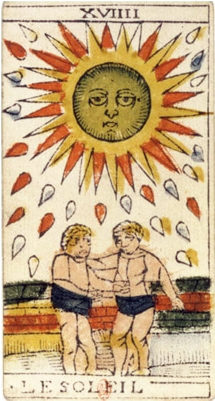
Jean Dodal · Lyon, 1701–1715
Open the source image ↗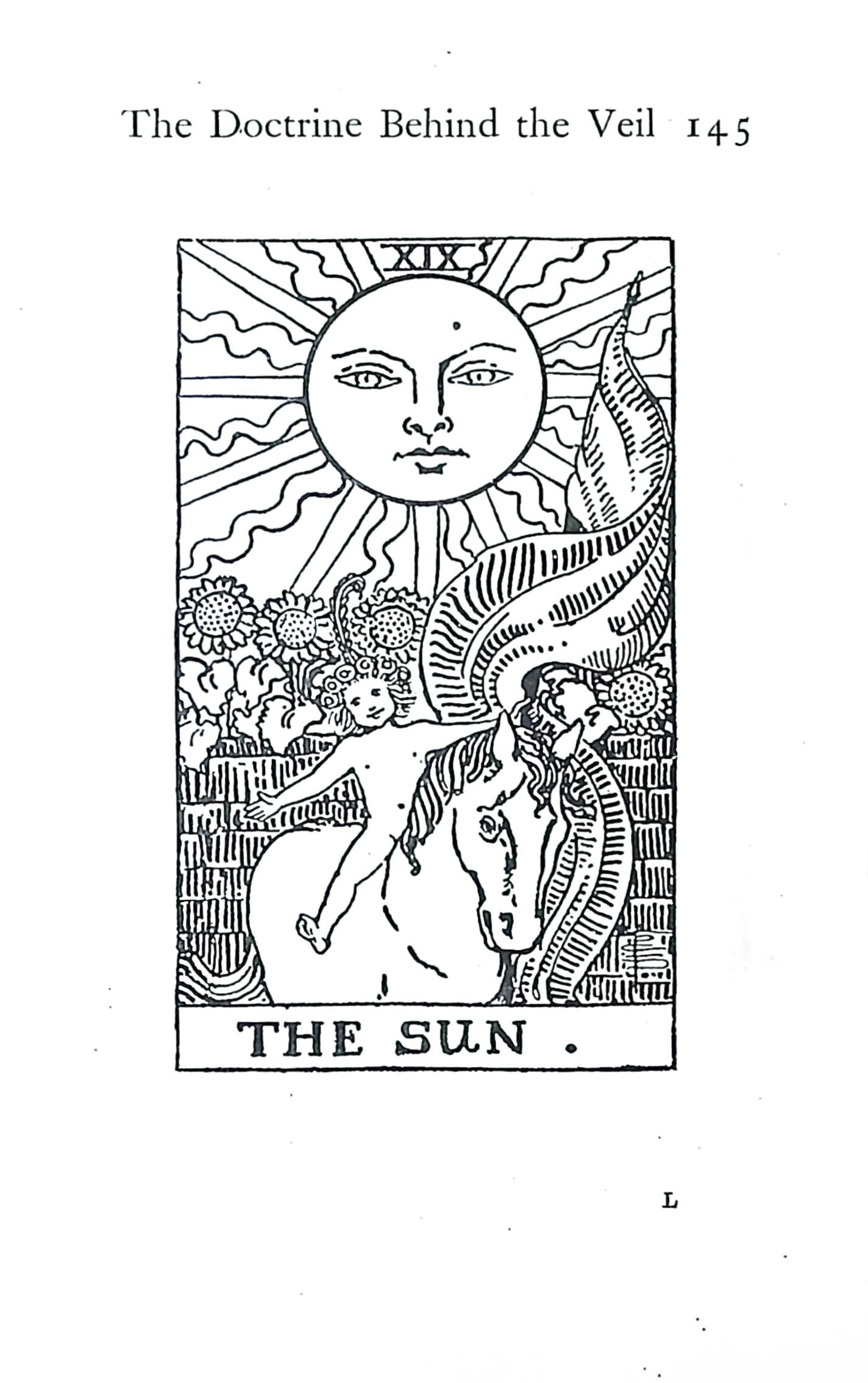
Pamela Colman Smith · 1922 printing, p. 145
Open the source scan page ↗Dodal
Two lightly clothed figures touch near a low wall beneath a large sun with a face. Straight and curved rays alternate around the disk, with coloured drop-like marks below.
Smith
A child sits on a horse before a wall and sunflowers, holding a large flowing banner. A sun with a face fills the sky.
Harris
Two small winged figures raise their arms before a green mound encircled by a wall. A flower-like solar disk sends long rays across the scene. Zodiacal figures ring the outer edge.
Open Harris’s painting and reference page ↗Waite contrasts direct spiritual consciousness with the Moon’s reflected light. The child represents simplicity and innocence within his account of renewal; the explanation extends beyond ordinary happiness.
Crowley places the Sun within his theology of liberation.
Write one thing you can point to in the image, one interpretation from a named author, and one inference of your own. Keeping the three separate gives you something useful to revisit.
Gabriel develops renewal and consciousness through solar imagery. His wider claims about the origins of religions require separate historical evidence; the pictured scenes do not establish them.
The Dodal cards are one early-eighteenth-century Marseille witness. The black-and-white Smith plates come from the 1922 Rider reprint, whose title verso lists first publication in 1910. Colours in later editions can differ.
The images shown here are reproduced from public-domain sources, with their original borders and page context.
Harris’s paintings are linked on their host’s reference pages. Crowley’s text is the separately identified Thelemagick transcription of The Book of Thoth. Neither a modern reproduction nor a transcription replaces examination of the original artwork or edition.
