Dodal
La Maison Dieu · XVI
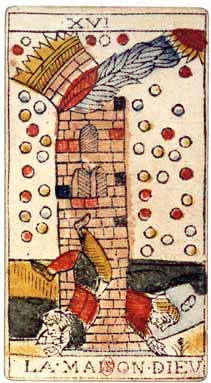
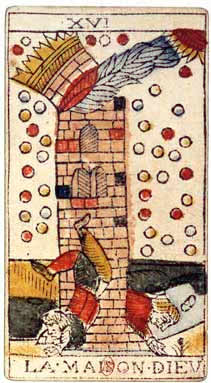
A tower’s crown-like top tilts away where a coloured streak meets it from the upper right. Small coloured circles surround the building. Two figures bend or fall toward the ground at its base.
Follow the force that meets the building. The displaced top remains recognizable, but the ray, lightning, eye and flames organize the scene differently.
Jean Dodal · Lyon, 1701–1715
Open the source image ↗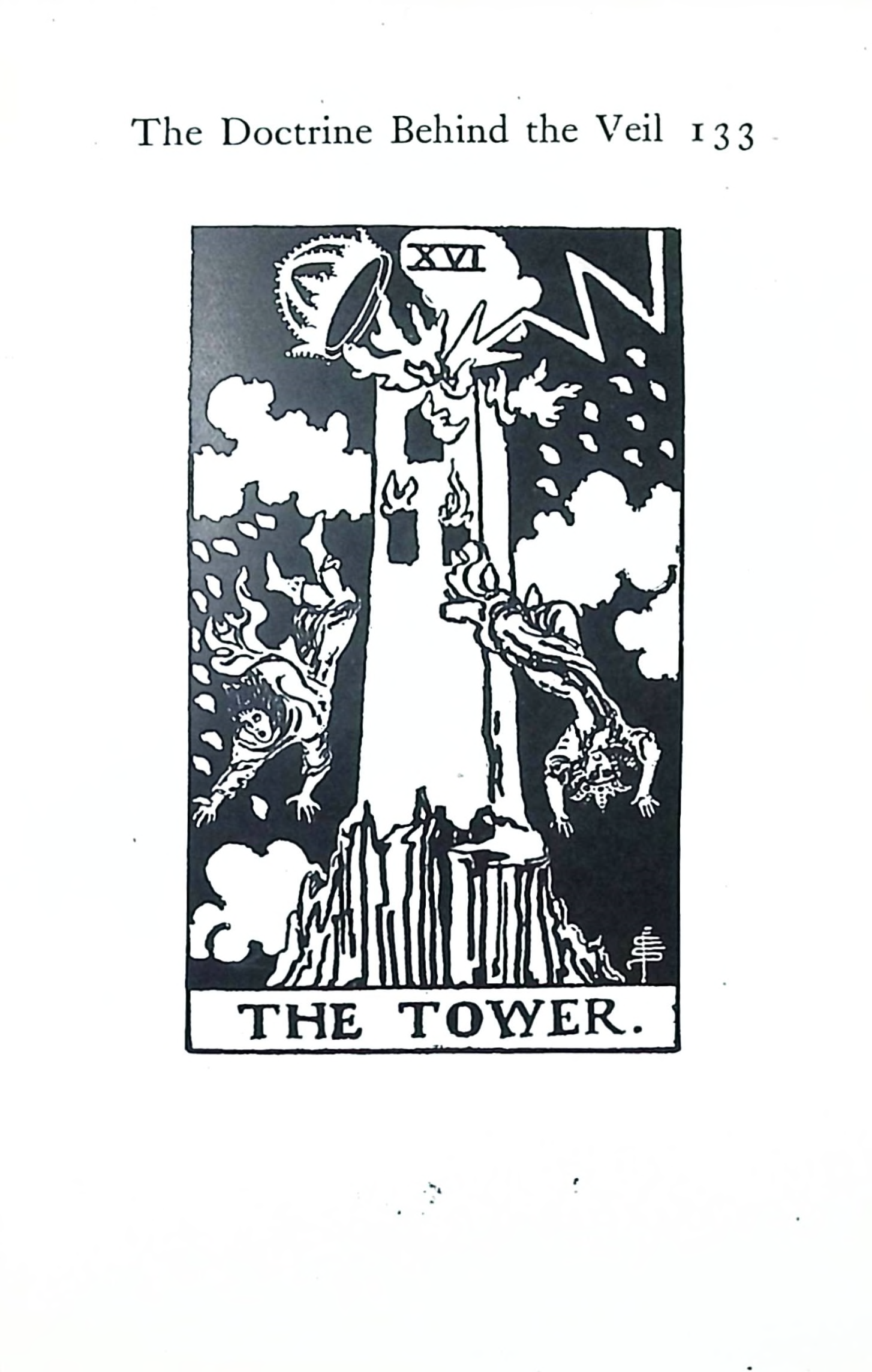
Pamela Colman Smith · 1922 printing, p. 133
Open the source scan page ↗Dodal
A tower’s crown-like top tilts away where a coloured streak meets it from the upper right. Small coloured circles surround the building. Two figures bend or fall toward the ground at its base.
Smith
Lightning strikes a tower and dislodges its crown. Flames emerge as two figures fall on either side.
Harris
A large eye radiates over a broken, angular tower. Open jaws send bands of flame across the lower scene, while angular human-like forms fall through the middle. A bird and a serpent occupy the upper sides.
Open Harris’s painting and reference page ↗Waite develops the visible destruction into the collapse of false doctrine and its interpretation. He resists treating the scene only as a generic punishment of pride or a literal retelling of the Fall.
Crowley connects the destruction with Mars and a new Aeon.
Write one thing you can point to in the image, one interpretation from a named author, and one inference of your own. Keeping the three separate gives you something useful to revisit.
Gabriel contrasts the moods of the three images and considers creation alongside destruction. Keep that theological discussion separate from any claim that real suffering is deserved or beneficial.
The Dodal cards are one early-eighteenth-century Marseille witness. The black-and-white Smith plates come from the 1922 Rider reprint, whose title verso lists first publication in 1910. Colours in later editions can differ.
The images shown here are reproduced from public-domain sources, with their original borders and page context.
Harris’s paintings are linked on their host’s reference pages. Crowley’s text is the separately identified Thelemagick transcription of The Book of Thoth. Neither a modern reproduction nor a transcription replaces examination of the original artwork or edition.
