Dodal, linked reproduction
Quatre de Coupes
Jean Dodal’s Marseille pack · Lyon, 1701–1715.
Read the BnF catalogue record ↗An ordered group of four can look settled while its accompanying account introduces unease.
Dodal, linked reproduction
Jean Dodal’s Marseille pack · Lyon, 1701–1715.
Read the BnF catalogue record ↗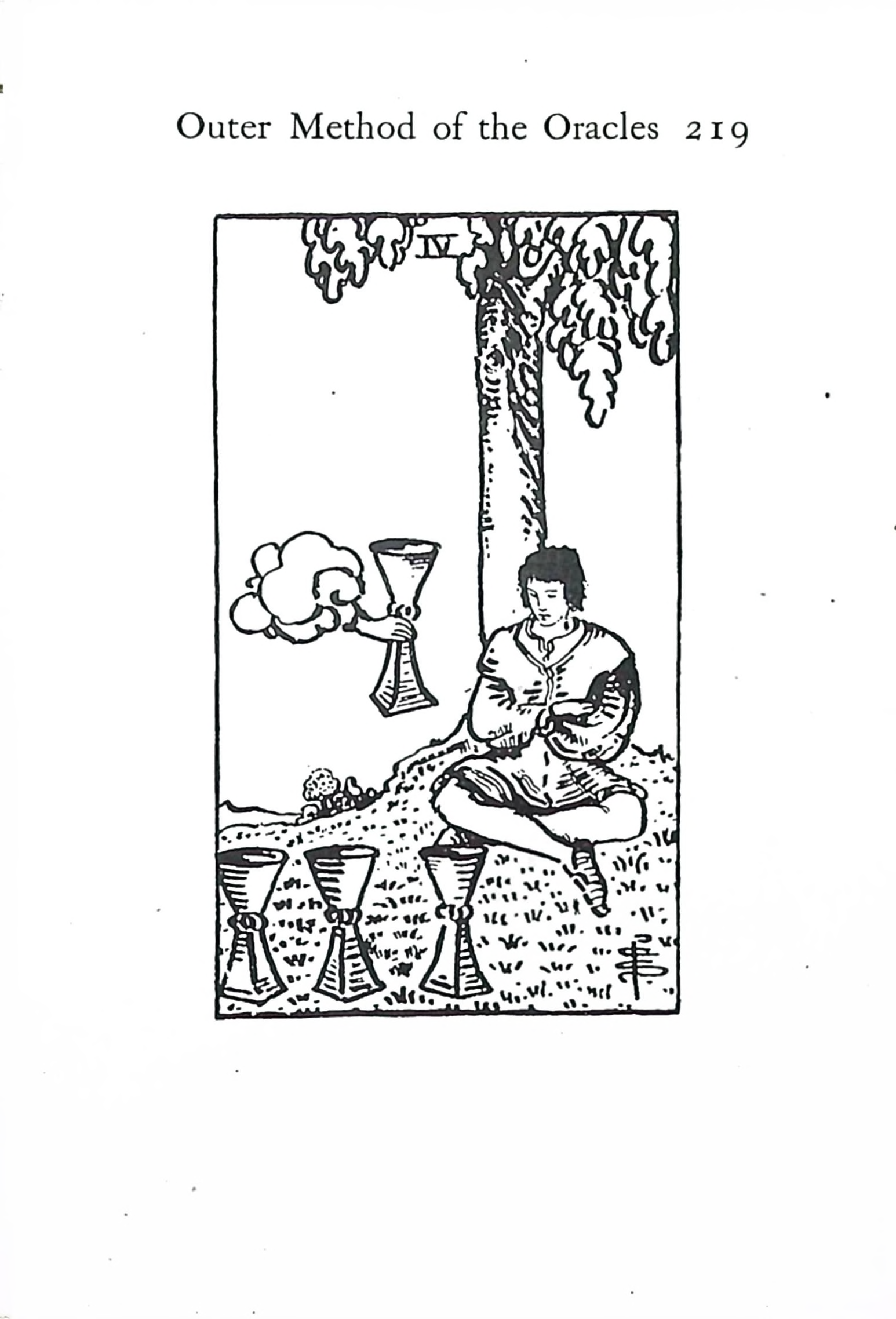
Pamela Colman Smith · 1922 printing, p. 219
Open the source scan page ↗Dodal
Four cups occupy two tiers around a central floral stem. Their repeated shapes and the surrounding leaves form a balanced pattern.
Smith
A figure sits beneath a tree with folded arms before three cups. A hand emerging from a cloud offers a fourth.
Harris
Four gold cups stand in two tiers, linked by streams of water. Red stems and broad blossoms rise above them against a blue background.
Open Harris’s painting and reference page ↗Waite emphasizes weariness and dissatisfaction even in the presence of a further offer. His reversed list turns toward novelty and new relations, rather than merely increasing the original discontent.
Crowley calls this Luxury: Water has consolidated through Chesed and the Moon in Cancer, but its stability contains the possibility of decay. He describes pleasure becoming restricted by its own settled form.
Write one thing you can point to in the image, one interpretation from a named author, and one inference of your own. Keeping the three separate gives you something useful to revisit.
The Dodal cards are one early-eighteenth-century Marseille witness. The black-and-white Smith plates come from the 1922 Rider reprint, whose title verso lists first publication in 1910. Colours in later editions can differ.
Foolmade supplies the linked Dodal reproductions. Its surrounding commentary is not the basis for our historical claims. These images are linked externally; the Smith illustration reuses the public-domain source scan with its full page context.
Harris’s paintings are linked on their host’s reference pages. Crowley’s text is the separately identified Thelemagick transcription of The Book of Thoth. Neither a modern reproduction nor a transcription replaces examination of the original artwork or edition.