Dodal, linked reproduction
Six d'Épées
Jean Dodal’s Marseille pack · Lyon, 1701–1715.
Read the BnF catalogue record ↗Six swords can travel with people or gather around a single centre.
Dodal, linked reproduction
Jean Dodal’s Marseille pack · Lyon, 1701–1715.
Read the BnF catalogue record ↗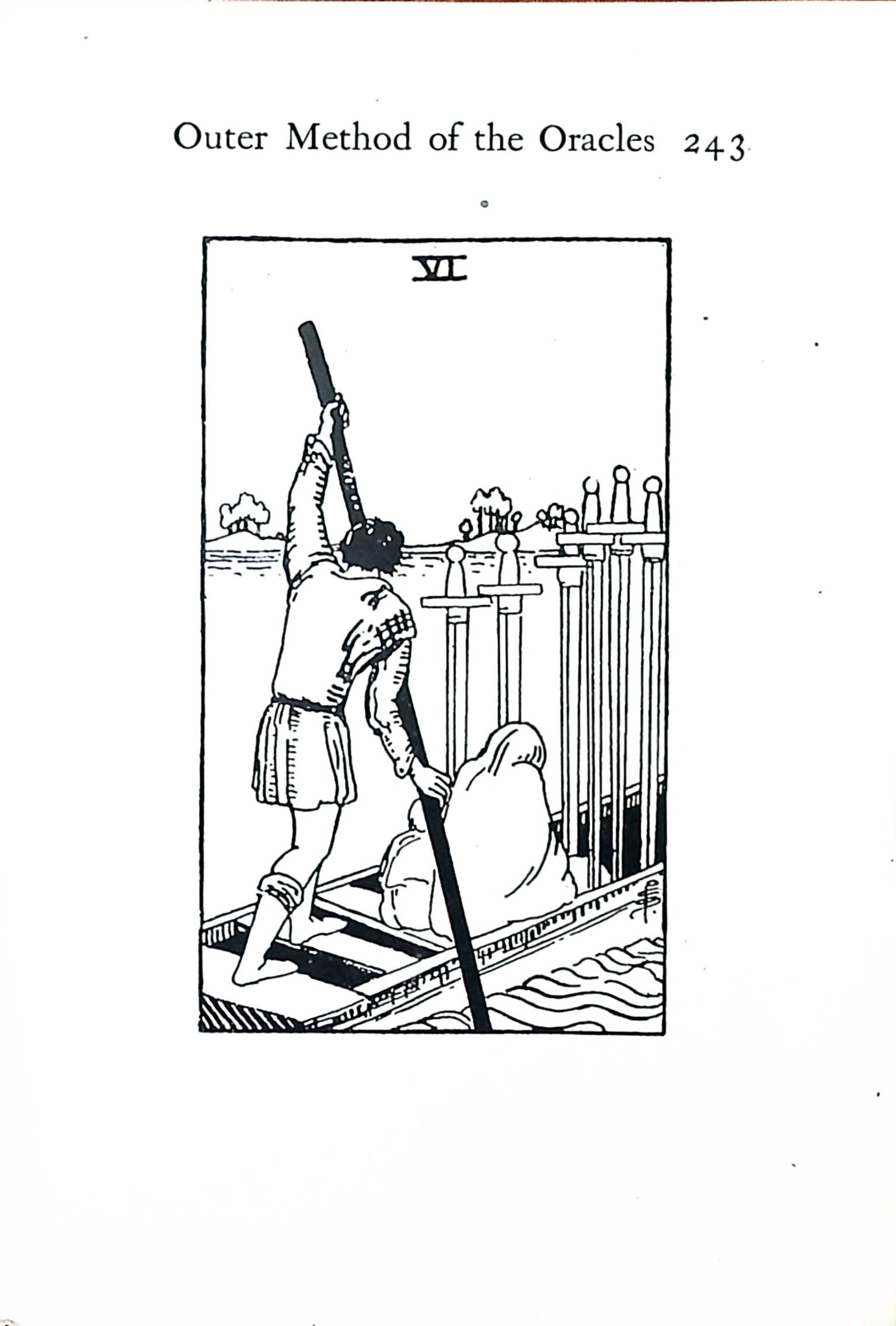
Pamela Colman Smith · 1922 printing, p. 243
Open the source scan page ↗Dodal
Three pairs of curved blades enclose a central flower. The repeated curves and crossing ends give the composition a layered, symmetrical outline.
Smith
A standing boatman uses a pole behind two seated passengers. Six swords stand in the boat, and land is visible across the water.
Harris
Six straight blades converge on a small central rose-and-cross design. Their ornate hilts form a regular sixfold arrangement over geometric lines.
Open Harris’s painting and reference page ↗Waite concentrates on passage, routes and a manageable task. His text says the work is within the ferryman’s strength, rather than attributing one definite emotional history to the passengers.
Crowley calls this Science and connects Tiphareth and Mercury in Aquarius with a difficult balance of intellectual faculties. He identifies the central Rosy Cross within that symbolic account of truth.
Write one thing you can point to in the image, one interpretation from a named author, and one inference of your own. Keeping the three separate gives you something useful to revisit.
The Dodal cards are one early-eighteenth-century Marseille witness. The black-and-white Smith plates come from the 1922 Rider reprint, whose title verso lists first publication in 1910. Colours in later editions can differ.
Foolmade supplies the linked Dodal reproductions. Its surrounding commentary is not the basis for our historical claims. These images are linked externally; the Smith illustration reuses the public-domain source scan with its full page context.
Harris’s paintings are linked on their host’s reference pages. Crowley’s text is the separately identified Thelemagick transcription of The Book of Thoth. Neither a modern reproduction nor a transcription replaces examination of the original artwork or edition.