
Dodal
Untitled · XIII
A skeletal figure grips a long-handled scythe. XIII appears at the top. The lower part of this surviving reproduction is heavily worn, obscuring details that are clearer in some modern versions.
Dodal and Harris give the skeleton a scythe; Smith puts it on horseback with a banner. Begin with the action pictured, without turning the card into a forecast.
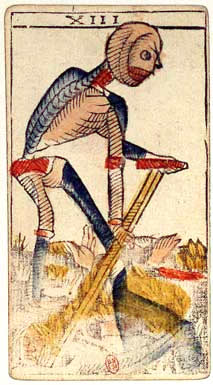
Jean Dodal · Lyon, 1701–1715
Open the source image ↗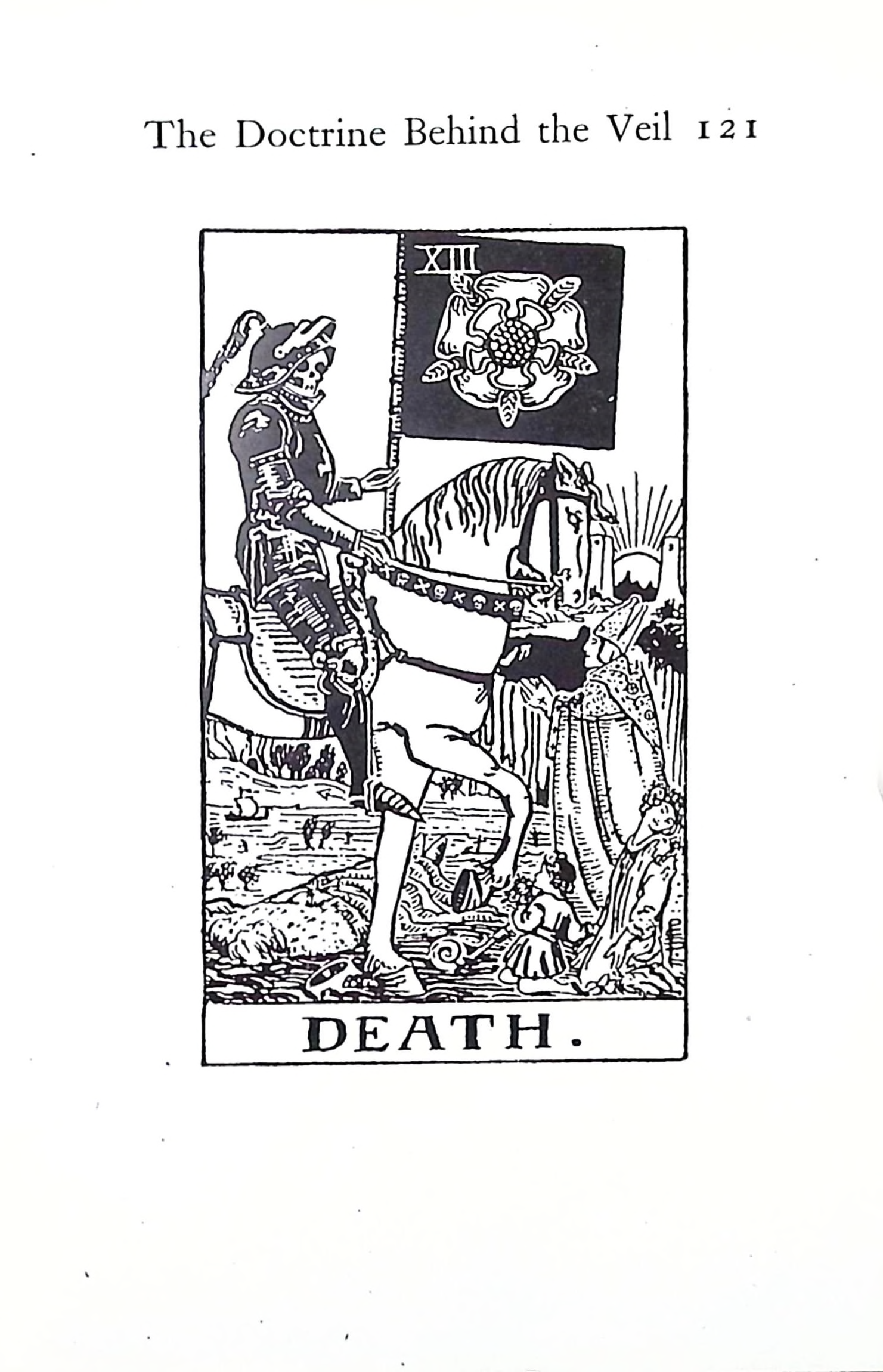
Pamela Colman Smith · 1922 printing, p. 121
Open the source scan page ↗Dodal
A skeletal figure grips a long-handled scythe. XIII appears at the top. The lower part of this surviving reproduction is heavily worn, obscuring details that are clearer in some modern versions.
Smith
A skeletal rider carries a flower-emblazoned banner past fallen and kneeling figures. The sun appears between distant towers.
Harris
A dark skeleton wearing a tall headdress sweeps a scythe through curved lines and small figure-like forms. A serpent stretches along the lower edge, beside a scorpion and fish-like shapes.
Open Harris’s painting and reference page ↗Waite discusses passage and transformation, including both ordinary death and a distinct mystical change of consciousness during life. He treats the rose on the banner as a sign of life within this account.
Crowley relates the card to Scorpio and alchemical putrefaction.
Write one thing you can point to in the image, one interpretation from a named author, and one inference of your own. Keeping the three separate gives you something useful to revisit.
Gabriel develops transformation and mortality through the three designs. His biological and historical examples need their own evidence; they are not established simply by appearing in a tarot commentary.
The Dodal cards are one early-eighteenth-century Marseille witness. The black-and-white Smith plates come from the 1922 Rider reprint, whose title verso lists first publication in 1910. Colours in later editions can differ.
The images shown here are reproduced from public-domain sources, with their original borders and page context.
Harris’s paintings are linked on their host’s reference pages. Crowley’s text is the separately identified Thelemagick transcription of The Book of Thoth. Neither a modern reproduction nor a transcription replaces examination of the original artwork or edition.
