Dodal
Le Diable · XV
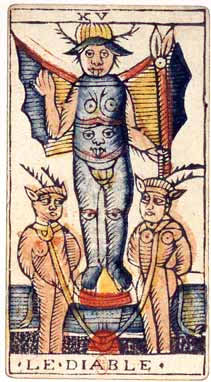
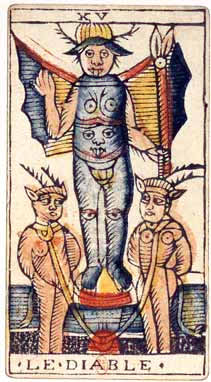
A winged figure stands above two smaller horned figures. Cords run from their necks toward the central support. The larger body has a face-like form on its abdomen and holds a long implement beside one wing.
Look at the connection between the large figure and the smaller ones. Cords, chains and enclosed groups make different kinds of relationship visible.
Jean Dodal · Lyon, 1701–1715
Open the source image ↗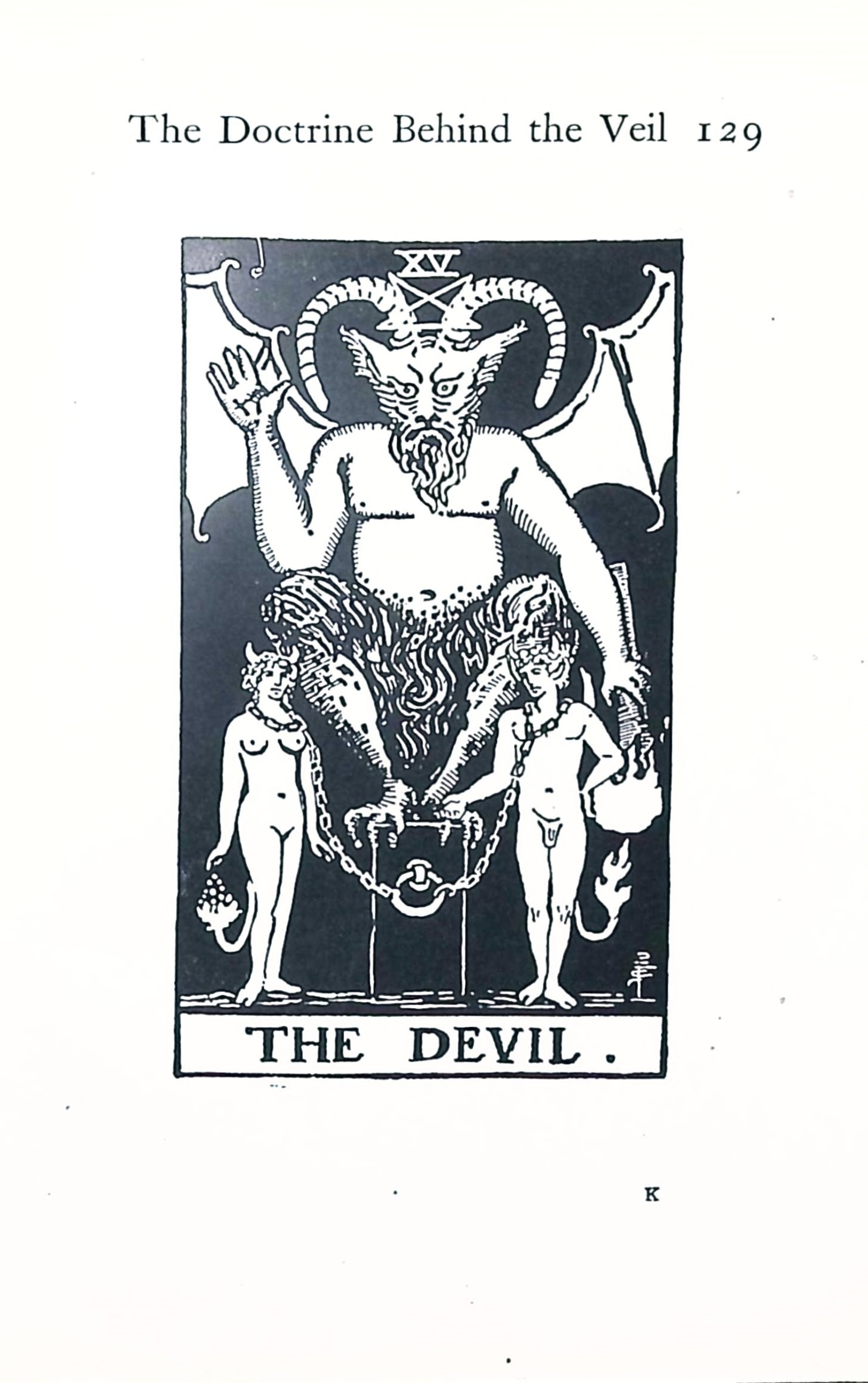
Pamela Colman Smith · 1922 printing, p. 129
Open the source scan page ↗Dodal
A winged figure stands above two smaller horned figures. Cords run from their necks toward the central support. The larger body has a face-like form on its abdomen and holds a long implement beside one wing.
Smith
A horned, winged figure crouches above two smaller figures chained at the neck. It raises one hand and holds a downward-pointing torch in the other.
Harris
A goat with long, twisting horns faces outward before a tall central form. A winged staff stands in front of its legs. Two rounded enclosures below contain groups of small human figures.
Open Harris’s painting and reference page ↗Waite connects the chains with material and animal life, yet says the dominating figure will not rule its captives forever. His explanation is a particular account of bondage and possible release.
Crowley treats the card as material creative energy.
Write one thing you can point to in the image, one interpretation from a named author, and one inference of your own. Keeping the three separate gives you something useful to revisit.
Gabriel reads the designs through desire and repression. His discussion includes clinical analogies; the comparison here treats those as commentary, not as explanations or assessments of mental illness.
The Dodal cards are one early-eighteenth-century Marseille witness. The black-and-white Smith plates come from the 1922 Rider reprint, whose title verso lists first publication in 1910. Colours in later editions can differ.
The images shown here are reproduced from public-domain sources, with their original borders and page context.
Harris’s paintings are linked on their host’s reference pages. Crowley’s text is the separately identified Thelemagick transcription of The Book of Thoth. Neither a modern reproduction nor a transcription replaces examination of the original artwork or edition.
