Dodal, linked reproduction
Cinq de Bâtons
Jean Dodal’s Marseille pack · Lyon, 1701–1715.
Read the BnF catalogue record ↗Smith supplies people to a tangle of staves; Harris gives the implements different forms and positions.
Dodal, linked reproduction
Jean Dodal’s Marseille pack · Lyon, 1701–1715.
Read the BnF catalogue record ↗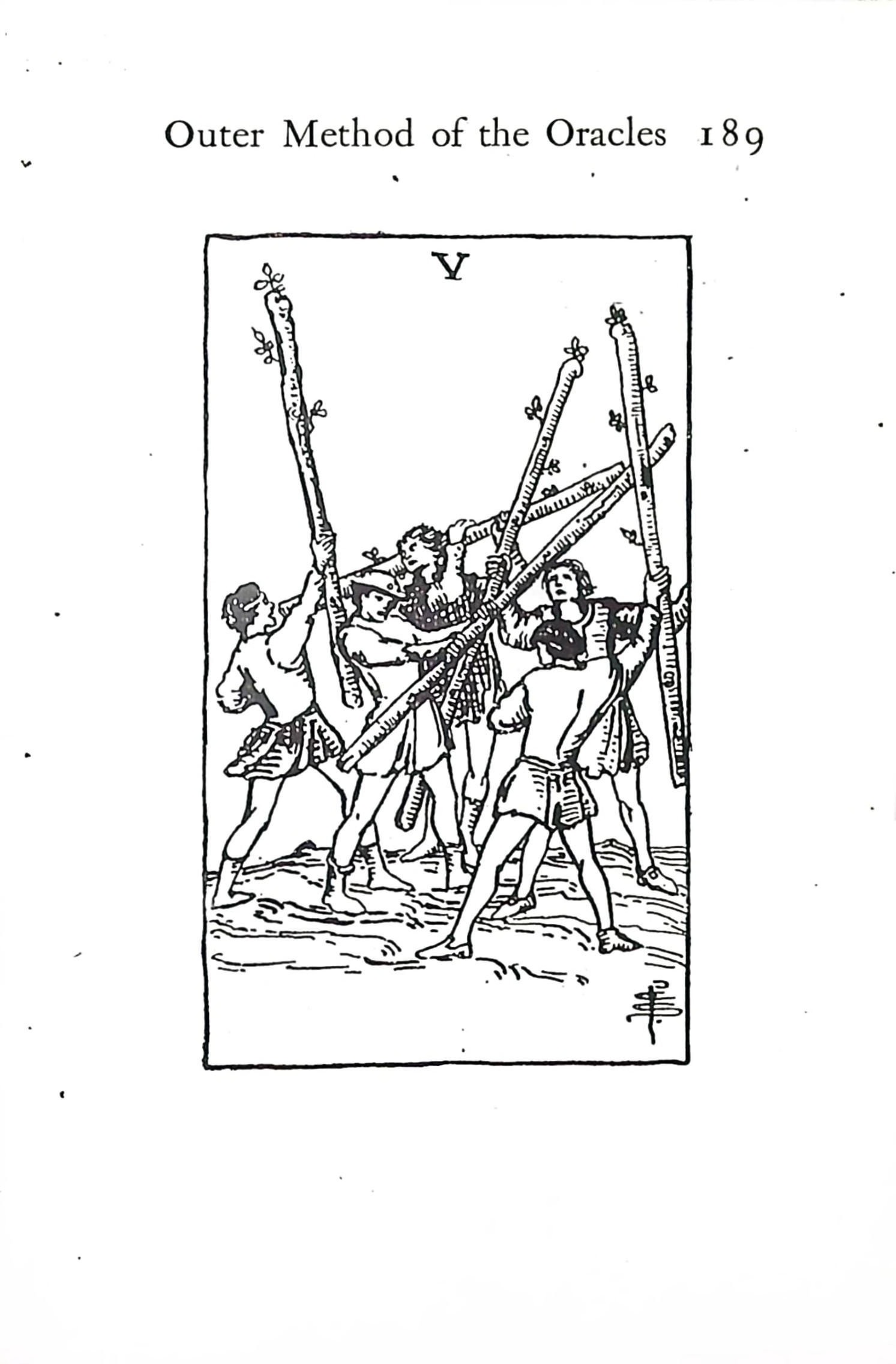
Pamela Colman Smith · 1922 printing, p. 189
Open the source scan page ↗Dodal
A central upright baton passes through two crossed pairs. The symmetrical arrangement is surrounded by small plant ornaments, without people handling the sticks.
Smith
Five figures raise and cross leafy staffs in a crowded, uneven arrangement. No single figure has a visibly settled advantage.
Harris
A prominent upright staff stands over two diagonal pairs of different designs. Winged and curved forms cap the implements, with flames rising through the composition.
Open Harris’s painting and reference page ↗Waite calls the scene a mimic battle, connecting it with competition and the struggle for advantage. His account leaves room for sport-like imitation as well as serious rivalry.
Crowley calls the card Strife, associating Geburah’s Fire with Saturn in Leo. He identifies the three kinds of wand with ritual officers and describes force under pressure, rather than a literal scene of five people fighting.
Write one thing you can point to in the image, one interpretation from a named author, and one inference of your own. Keeping the three separate gives you something useful to revisit.
The Dodal cards are one early-eighteenth-century Marseille witness. The black-and-white Smith plates come from the 1922 Rider reprint, whose title verso lists first publication in 1910. Colours in later editions can differ.
Foolmade supplies the linked Dodal reproductions. Its surrounding commentary is not the basis for our historical claims. These images are linked externally; the Smith illustration reuses the public-domain source scan with its full page context.
Harris’s paintings are linked on their host’s reference pages. Crowley’s text is the separately identified Thelemagick transcription of The Book of Thoth. Neither a modern reproduction nor a transcription replaces examination of the original artwork or edition.