Dodal
L’Amoureux · VI
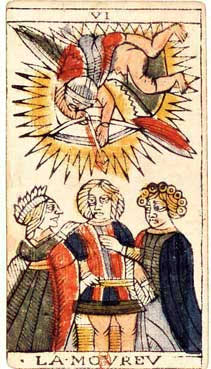
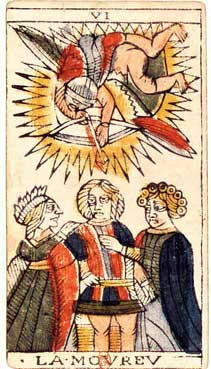
Three clothed figures stand close together, their hands reaching across the central person. Above them a small winged figure aims a bow downward from a radiating enclosure.
Count the people and follow their hands. A central figure between two others, a pair beneath an angel, and a crowded royal ceremony do not tell the same scene.
Jean Dodal · Lyon, 1701–1715
Open the source image ↗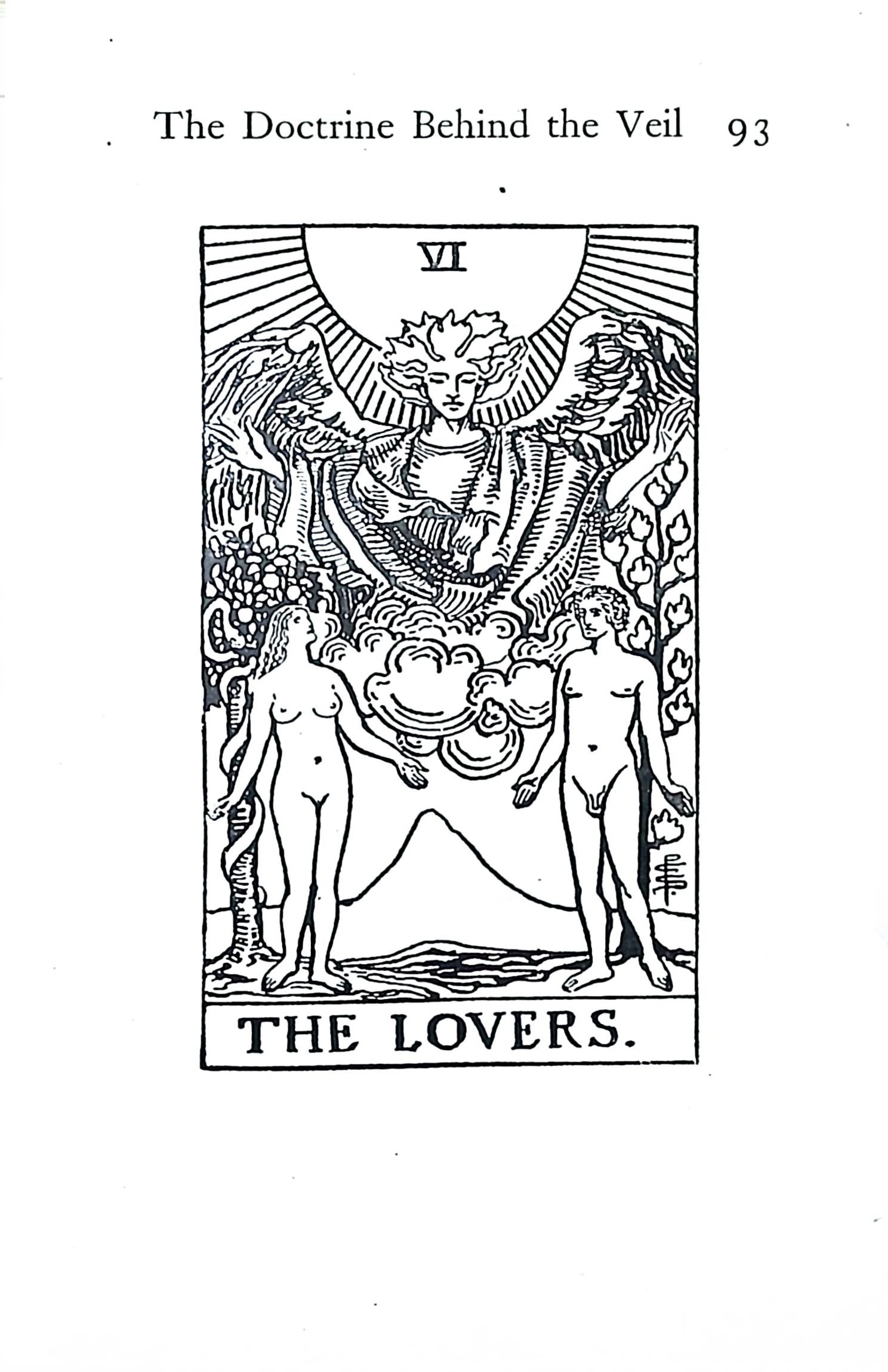
Pamela Colman Smith · 1922 printing, p. 93
Open the source scan page ↗Dodal
Three clothed figures stand close together, their hands reaching across the central person. Above them a small winged figure aims a bow downward from a radiating enclosure.
Smith
Two unclothed figures stand beneath a winged figure and the sun. Behind them are two different trees; a serpent winds around the tree on the left.
Harris
Two crowned figures meet beneath a large hooded figure with outstretched arms. Two children stand below them, flanked by a lion and a pale bird. A winged figure with a bow hovers above the ceremony.
Open Harris’s painting and reference page ↗Waite replaces a choice between vice and virtue with an Edenic account of human love. His explanation uses Adam, Eve, covenant and providence, preserving a specific theological story rather than a universal relationship formula.
Crowley pairs the Lovers’ analysis with Art’s later synthesis.
Write one thing you can point to in the image, one interpretation from a named author, and one inference of your own. Keeping the three separate gives you something useful to revisit.
Gabriel reads love through competing forms of choice and union. Use the different casts of figures to test those readings without turning every version into the same relationship advice.
The Dodal cards are one early-eighteenth-century Marseille witness. The black-and-white Smith plates come from the 1922 Rider reprint, whose title verso lists first publication in 1910. Colours in later editions can differ.
The images shown here are reproduced from public-domain sources, with their original borders and page context.
Harris’s paintings are linked on their host’s reference pages. Crowley’s text is the separately identified Thelemagick transcription of The Book of Thoth. Neither a modern reproduction nor a transcription replaces examination of the original artwork or edition.
