
Dodal
La Lune · XVIII
Two dog-like animals face upward between towers beneath a moon with a face. Drop-shaped marks fill the sky. A large crustacean occupies the water in the foreground.
Two towers, animals and a shelled creature survive substantial changes. Compare their positions and the route through the centre, then read the authors’ accounts of darkness.
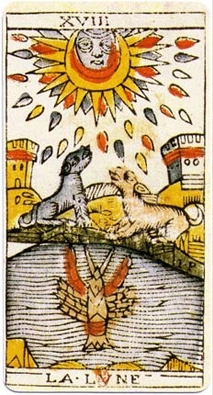
Jean Dodal · Lyon, 1701–1715
Open the source image ↗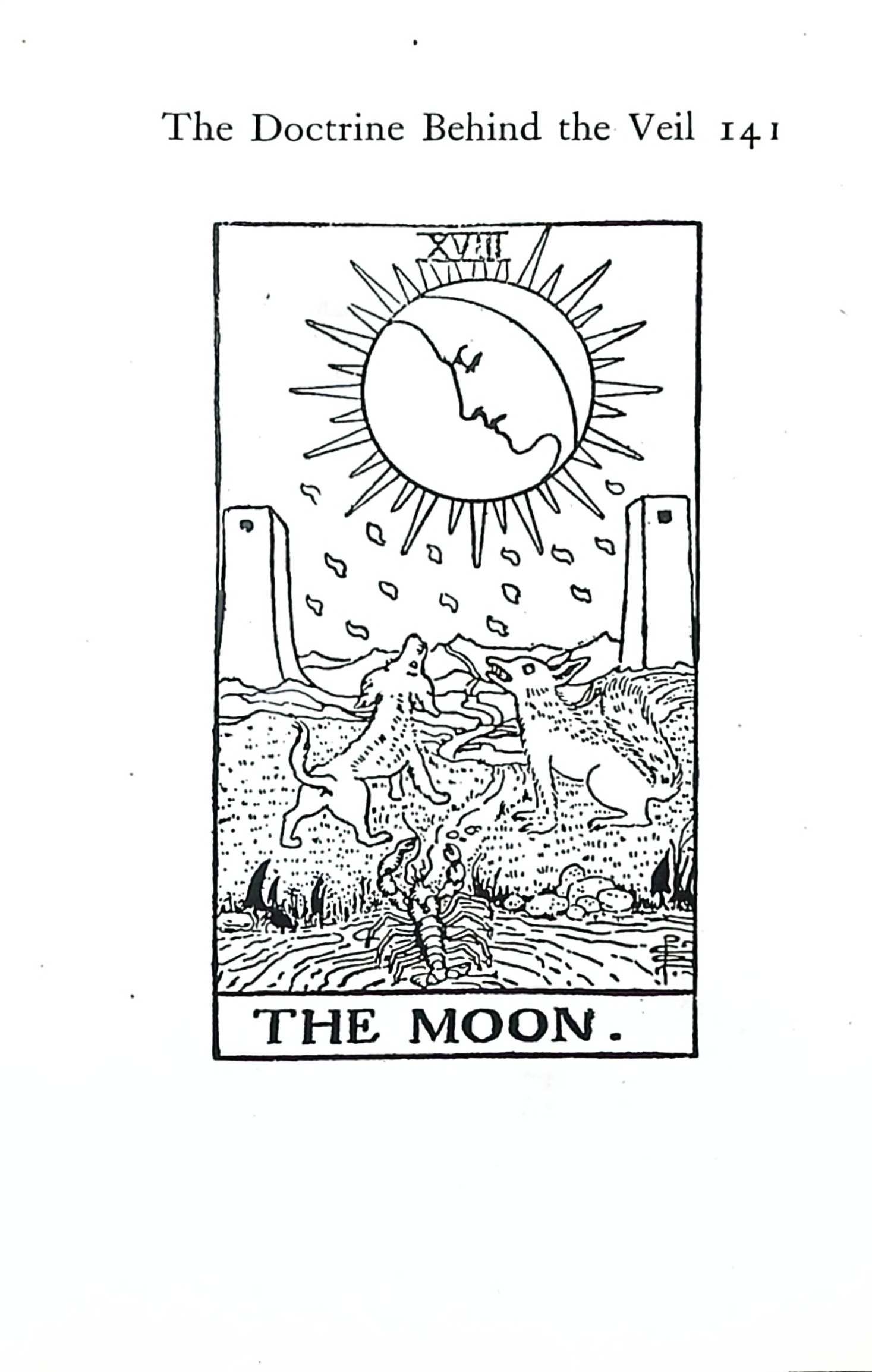
Pamela Colman Smith · 1922 printing, p. 141
Open the source scan page ↗Dodal
Two dog-like animals face upward between towers beneath a moon with a face. Drop-shaped marks fill the sky. A large crustacean occupies the water in the foreground.
Smith
A crayfish emerges from water between a dog and a wolf. A path continues between two towers beneath a moon with a face.
Harris
Two jackal-headed standing figures face inward before dark towers, with small jackals at their feet. A beetle bears a bright disk below the central passage. The moon above has curved bands rather than a human face.
Open Harris’s painting and reference page ↗Waite distinguishes imagination and reflected intellectual light from direct spiritual illumination. The animals become aspects of the natural mind confronting an unknown that this reflected light cannot fully reveal.
Crowley describes Khephra carrying the Sun through darkness.
Write one thing you can point to in the image, one interpretation from a named author, and one inference of your own. Keeping the three separate gives you something useful to revisit.
Gabriel reads the images through the unconscious and the prospect of daylight. His claims about lunar effects are not used here as scientific or medical evidence.
The Dodal cards are one early-eighteenth-century Marseille witness. The black-and-white Smith plates come from the 1922 Rider reprint, whose title verso lists first publication in 1910. Colours in later editions can differ.
The images shown here are reproduced from public-domain sources, with their original borders and page context.
Harris’s paintings are linked on their host’s reference pages. Crowley’s text is the separately identified Thelemagick transcription of The Book of Thoth. Neither a modern reproduction nor a transcription replaces examination of the original artwork or edition.
