
Dodal
La Papesse · II
A crowned figure holds an open book across the lap. A tall, tiered headdress rises between hanging cloths; the face turns to one side. There are no lettered pillars beside the seat.
Follow what can be read, and what remains covered. These three seated figures give very different forms to the boundary between showing and withholding.
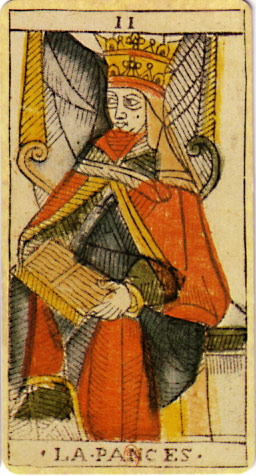
Jean Dodal · Lyon, 1701–1715
Open the source image ↗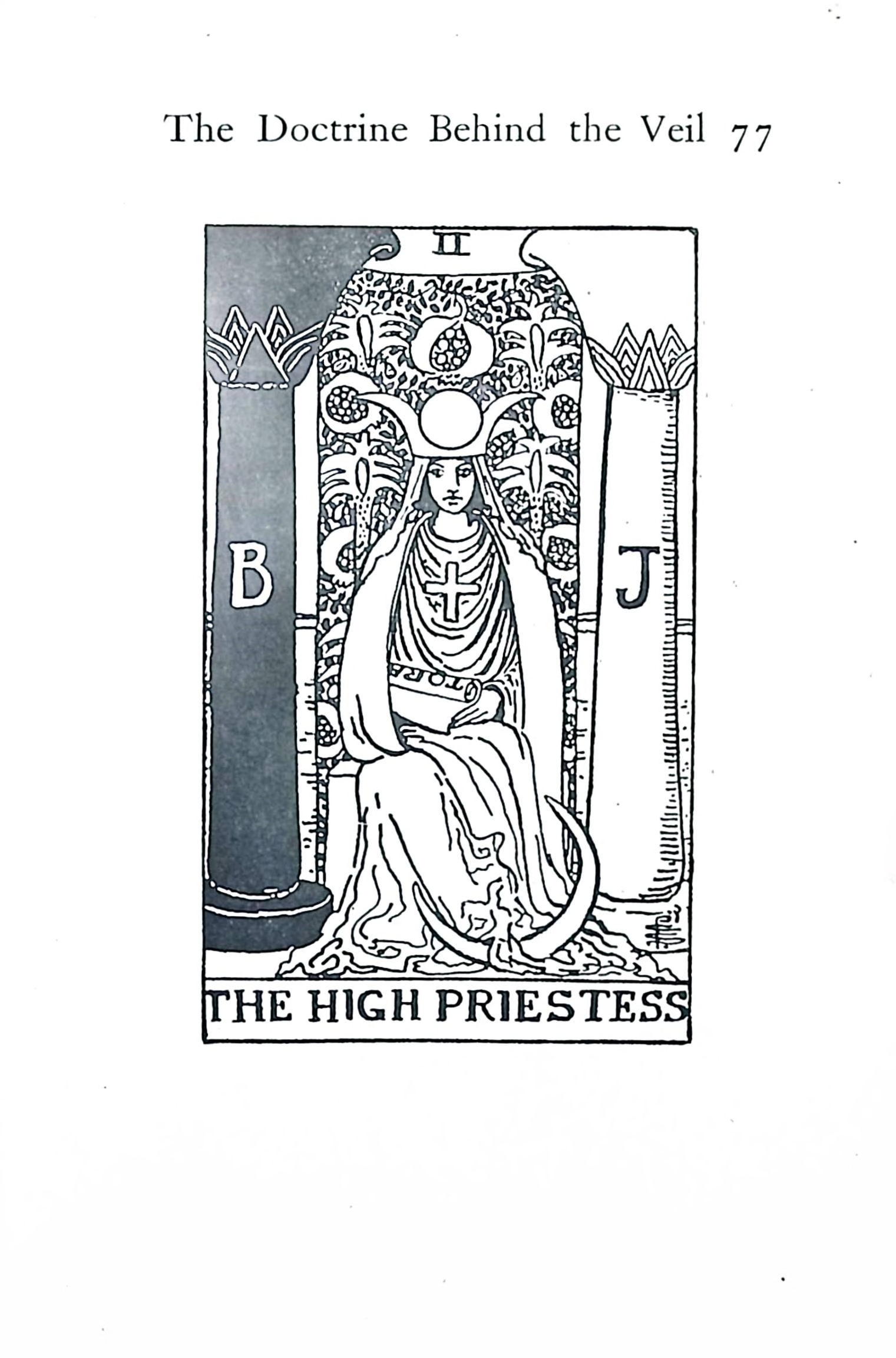
Pamela Colman Smith · 1922 printing, p. 77
Open the source scan page ↗Dodal
A crowned figure holds an open book across the lap. A tall, tiered headdress rises between hanging cloths; the face turns to one side. There are no lettered pillars beside the seat.
Smith
A seated figure holds a partly covered scroll between pillars marked B and J. A crescent rests by her feet, and a patterned veil hangs behind her.
Harris
The figure extends both arms across a web of curved, luminous bands. A bow-shaped form crosses the lap. Small flowers, angular forms and a camel occupy the lower edge.
Open Harris’s painting and reference page ↗Waite makes the partly concealed scroll a distinction between expressed and implied knowledge. His account moves through the spiritual bride, reflected light and the Shekinah; these are his theological identifications, not labels printed on every detail.
Crowley identifies the luminous veil with spiritual light.
Write one thing you can point to in the image, one interpretation from a named author, and one inference of your own. Keeping the three separate gives you something useful to revisit.
Gabriel’s broader discussion considers mediation and hidden knowledge. Check its individual picture descriptions against the reproductions; a persuasive interpretation can still contain a misplaced description.
The Dodal cards are one early-eighteenth-century Marseille witness. The black-and-white Smith plates come from the 1922 Rider reprint, whose title verso lists first publication in 1910. Colours in later editions can differ.
The images shown here are reproduced from public-domain sources, with their original borders and page context.
Harris’s paintings are linked on their host’s reference pages. Crowley’s text is the separately identified Thelemagick transcription of The Book of Thoth. Neither a modern reproduction nor a transcription replaces examination of the original artwork or edition.
