Dodal, linked reproduction
Deux de Bâtons
Jean Dodal’s Marseille pack · Lyon, 1701–1715.
Read the BnF catalogue record ↗Two implements can form a pattern, frame a person or concentrate a force.
Dodal, linked reproduction
Jean Dodal’s Marseille pack · Lyon, 1701–1715.
Read the BnF catalogue record ↗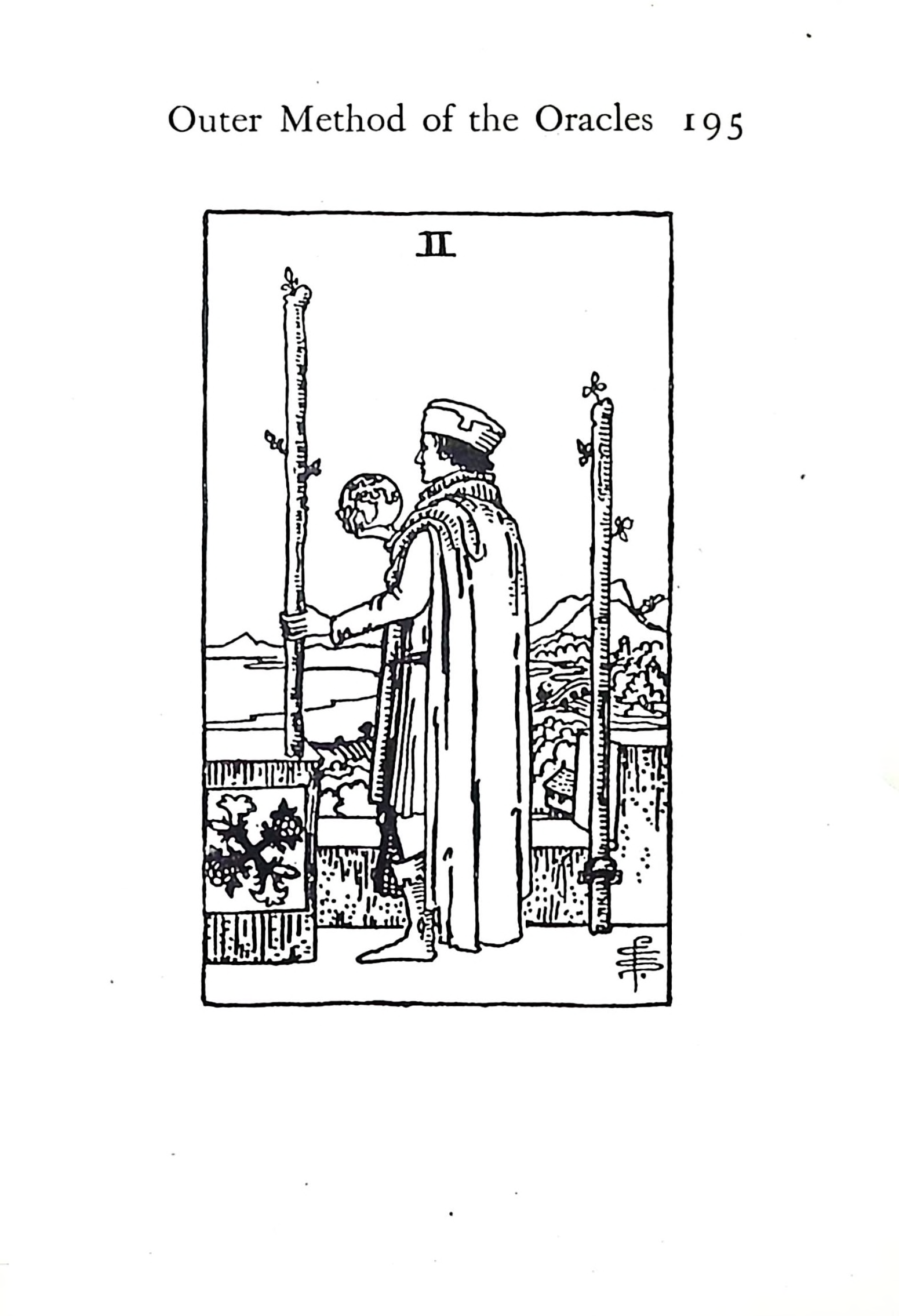
Pamela Colman Smith · 1922 printing, p. 195
Open the source scan page ↗Dodal
Two straight batons cross diagonally, with coloured bands at their meeting. Leaf-and-flower ornaments fill the spaces around them; there is no human figure.
Smith
A figure on a battlement holds a small globe and one staff, while another staff is fixed nearby. A floral emblem appears on the wall.
Harris
Two red implements with elaborate heads cross against an orange-red field. Small flames appear around their intersection.
Open Harris’s painting and reference page ↗Waite preserves incompatible readings of splendour and dissatisfaction. His example is someone whose worldly dominion does not prevent sadness; he does not resolve the card into uncomplicated ambition.
Crowley connects Dominion with Chokmah and Mars in Aries. He identifies the crossed implements as dorjes and treats their force as initiating action, including destruction as a stage of creation.
Write one thing you can point to in the image, one interpretation from a named author, and one inference of your own. Keeping the three separate gives you something useful to revisit.
The Dodal cards are one early-eighteenth-century Marseille witness. The black-and-white Smith plates come from the 1922 Rider reprint, whose title verso lists first publication in 1910. Colours in later editions can differ.
Foolmade supplies the linked Dodal reproductions. Its surrounding commentary is not the basis for our historical claims. These images are linked externally; the Smith illustration reuses the public-domain source scan with its full page context.
Harris’s paintings are linked on their host’s reference pages. Crowley’s text is the separately identified Thelemagick transcription of The Book of Thoth. Neither a modern reproduction nor a transcription replaces examination of the original artwork or edition.